
S&P Global Ratings on Monday retained its forecast of 9 per cent contraction in the Indian economy for the current fiscal, saying even though there are now upside risks to growth but it will wait for more signs that COVID infections have stabilised or fallen. S&P, in its report on Asia Pacific, projected the Indian economy to grow at 10 per cent in the next fiscal.

Mutual funds (MFs) are set to be net sellers of Indian equities for the first time in the past seven financial years, having sold stocks worth about Rs 1.27 trillion so far in 2020-21 (FY21), making it the highest net sales on record in a financial year. MFs had been net buyers in the previous six financial years, including purchases of over Rs 1.41 trillion in FY18, Rs 88,152 crore in FY19, and Rs 91,814 crore in FY20. The last time they offloaded Indian equities was in FY14, when they net sold stocks worth Rs 21,159 crore. In contrast, foreign portfolio investors (FPIs) have ramped up buying in FY21, purchasing more than Rs 2.6 trillion worth of shares.


He is currently on a two-day swing to the crucial State of Iowa. On January 15, Iowa would kick off the 2024 Republican presidential primary season.

USAID looks forward to working with each to make financial inclusion a long-lasting and sustainable reality in India.

'Similar to the case of the digital payment system where the government created a public platform and others joined in, we are exploring a similar structure to create a PPP platform where the compute required for AI could be accessed by the small player.'

'If you want it to grow well and serve the true needs of the economy, it needs a lot of freedom and flexibility, which comes in terms of the reform objective set by the regulator.'

The Union Cabinet on Thursday approved a revision in the formula for pricing of natural gas and imposed cap or ceiling price to help cut CNG and piped cooking gas prices by up to 10 per cent. Natural gas produced from legacy or old fields, known as APM gas, will now be indexed to the price of imported crude oil instead of benchmarking it to gas prices in four surplus nations such as the US, Canada and Russia, Union I&B Miniser Anurag Thakur told reporters after a meeting of the Cabinet. APM gas will be priced at 10 per cent of the price of basket of crude oil that India imports (Indian basket of crude oil).

S&P Global Ratings on Tuesday kept India's economic growth forecast in the fiscal year to March 2022 unchanged at 9.5 per cent but raised its predictions for the subsequent year on broadening out of the recovery. The Indian economy had shrunk by 7.3 per cent in 2020-21 fiscal (April 2020 to March 2021) as pandemic induced restrictions battered business activity. The gradual lifting of the restrictions has helped the economy to rebound from pandemic lows.

Puri said the government has a moral duty to provide energy at affordable rates to consumers.
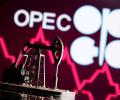
The surprise decision of OPEC and its allies, including Russia, to cut oil output may cause an immediate rise in prices, delaying revision in fuel prices in India, industry sources said. The grouping of Organisation of Petroleum Exporting Countries (OPEC) and its allies, called OPEC+, on Sunday decided to further cut oil output by around 1.16 million barrels. The move led to Brent rising by almost 6 per cent to $84.58 per barrel on Monday.

India's services sector lost momentum in July as demand was curtailed by competitive pressures, elevated inflation and unfavourable weather, a monthly survey said on Wednesday. The seasonally adjusted S&P Global India Services PMI Business Activity Index fell from 59.2 in June to 55.5 in July, pointing to the slowest rate of growth in four months. For the 12th straight month, the services sector witnessed an expansion in output. In Purchasing Managers' Index (PMI) parlance, a print above 50 means expansion while a score below 50 denotes contraction.

Governor Rajan can be more unambiguously pro-growth.

While the corporate sector has benefited from massive capital expenditure, leading to sky-rocketing stock prices, investors would do well to keep an eye on the macroeconomic picture and government finances, not just corporate profits, for signs of trouble, alerts Debashis Basu.

Stock markets in structural bull run but there can be bouts of volatility says Ravi Gopalakrishnan, head, equities, Canara Robeco Mutual Fund

Only 36 per cent in Japan and 44 per cent in Germany were willing to use such vehicles.

Gold has pushed lower as a result of Chinese selling.

Renting start-ups make a killing as millennials fuel sharing economy.

The BSE Sensex maintained its winning run for the fourth session on the trot on Wednesday to reclaim the 60,000-level after a gap of over four months as investors remained upbeat amid softening crude oil prices and persistent foreign fund inflows. A strengthening rupee and positive Asian markets further bolstered sentiment, traders said. The 30-share BSE benchmark jumped 417.92 points or 0.70 per cent to settle at 60,260.13 -- closing above the psychologically key 60,000-mark for the first time since April 5 this year.

'There was hardly any recruitment after the second wave.' 'Now, there is a huge demand for manpower.'
Consumer spending, which had been growing at 10 per cent year-on-year, will now decrease. Over 34 per cent of the respondents said they would cut spends, while 16 per cent said would spend more in the coming year. However, compared to other countries where the survey was conducted like Brazil, China, Mexico, Russia, Japan, Canada, United States and Europe , Indian consumers are more confident and optimistic.

Indian fast moving consumer goods (FMCG) players are once again on the prowl to acquire companies, as the economy picks up.

Reiterating his earlier stance, BJP's Rajya Sabha member Subramanian Swamy has written a letter to Prime Minister Narendra Modi, asking him to sack RBI Governor Raghuram Rajan.
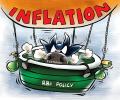
The Reserve Bank on Wednesday projected inflation to come down below the upper threshold level of 6 per cent by March quarter of the current fiscal. RBI Governor Shaktikanta Das said the central bank will keep 'Arjuna's eye' (focus) on the evolving inflation dynamics and will remain 'nimble and flexible' to deal with the price situation. Global commodity prices, including crude oil, have undergone some downward correction, but uncertainty continues to surround the near-term outlook in view of the prolonging geo-political hostilities. Moreover, the resurgence in domestic services sector activity could also lead to price increases, especially as firms pass on input costs.

'Yet the market didn't do all that badly because it was cushioned by domestic inflows.'

The Reserve Bank of India (RBI) on Wednesday raised the benchmark lending rate by 35 basis points to 6.25 per cent in a bid to tame inflation, which has remained above its tolerance level for the past 11 months. With the latest hike, the repo rate or the short-term lending rate at which banks borrow from the central bank now has crossed 6 per cent. This is the fifth consecutive rate hike after a 40 basis points increase in May and 50 basis points hike each in June, August and September.
India is busy building up its naval fleet, might add frigates, aircraft carriers, planes, submarines

The RBI refuses to classify a cryptocurrency as an asset since it doesn't have future cash flow and its value is always fluctuating because of speculation. There is also no consumer protection, observes Tamal Bandyopadhyay, and hence the e-rupee trial run.

Seven consecutive sessions of decline in the equity market has eroded the wealth of investors by a whopping Rs 10.42 lakh crore and the benchmark Sensex has tumbled more than 2,000 points during this period. Concerns over more rate hikes by developed economies, weak global equity markets and fresh foreign fund outflows from the domestic market have dented investor sentiments. On Monday, the BSE Sensex dropped 175.58 points or 0.30 per cent to end at 59,288.35 points, marking a decline for seven straight trading sessions.

Earnings growth, attractive valuations and change in FPI flows from negative to positive over the next 12 months are some of the key triggers for an upside. "A poor monsoon, high inflation and further rate hike are some of the key risks

'Markets could face uncertainty in the short to medium term.' 'It would be prudent to invest in alternative asset classes, especially debt, for about a year.' 'Bank fixed deposits are offering rates as high as 9 per cent per annum and these can be used as a great hedging tool until equity markets stabilise.'

'80% of the rural and urban population don't have enough purchasing power.'

India has built up buffers against cyclical difficulties and has ample foreign exchange reserves to withstand pressure on credit worthiness, S&P Global Ratings said on Thursday. Speaking at the India Credit Spotlight 2022 webinar, S&P Sovereign & International Public Finance Ratings director Andrew Wood said the country has a strong external balance sheet and limited external debt, making debt servicing not so expensive. "The country has built up buffers against cyclical difficulties like those, which we are experiencing right now," Wood said.

'Considering that an Internet company's market value is largely determined by its direct access to consumers for digital services, and largely served outside a sovereign country's control, it would appear reasonable in trade terms to discuss fees for a seat at the proverbial 'table' of opportunities in the largest open consumer market,' argues Venki Nishtala.

'In terms of semiconductors, challenges do remain in the pan industry, but I think we are much better than where we were a year or so back.'

The Lok Sabha elections in 2024 are not a consideration when it comes to monetary policymaking, said Reserve Bank of India governor Shaktikanta Das to underscore the central bank's commitment to controlling inflation. "It's not possible for me to comment what we do in the next MPC (Monetary Policy Committee), but one thing I can tell and I would like to make it very clear-that the fact of elections coming up in 2024 is not a factor at all so far as monetary policymaking is concerned. "Monetary policymaking is for checking (and) controlling inflation," Das said at the Business Standard, BFSI Insight Summit.

As a percentage contributor to nominal GDP, PFCE's share was 60.1 per cent in FY23, compared with 59.6 per cent and 60.8 per cent in the two preceding fiscal years. "Although PFCE is expected to grow 7.7 per cent in FY23, we believe it is still short of a broad-based recovery. "The current consumption demand is highly skewed in favour of goods and services consumed largely by the households falling in the upper income bracket. "A broad-based consumption recovery, therefore, is still some distance away," said Sunil Kumar Sinha, principal economist with India Ratings.

'The focus needs to shift towards the ability to collect payments, particularly in tier-3 to tier-4 areas where acceptance is still lacking.'
